Almost every business we talk to is being sold ai automation, and almost none of them have been told where it reliably works. The honest answer is that it pays off in narrow, unglamorous places and disappoints in exactly the places the demos focus on.
Here is the split, based on what we have shipped and what we have had to unpick.
Where ai automation actually pays
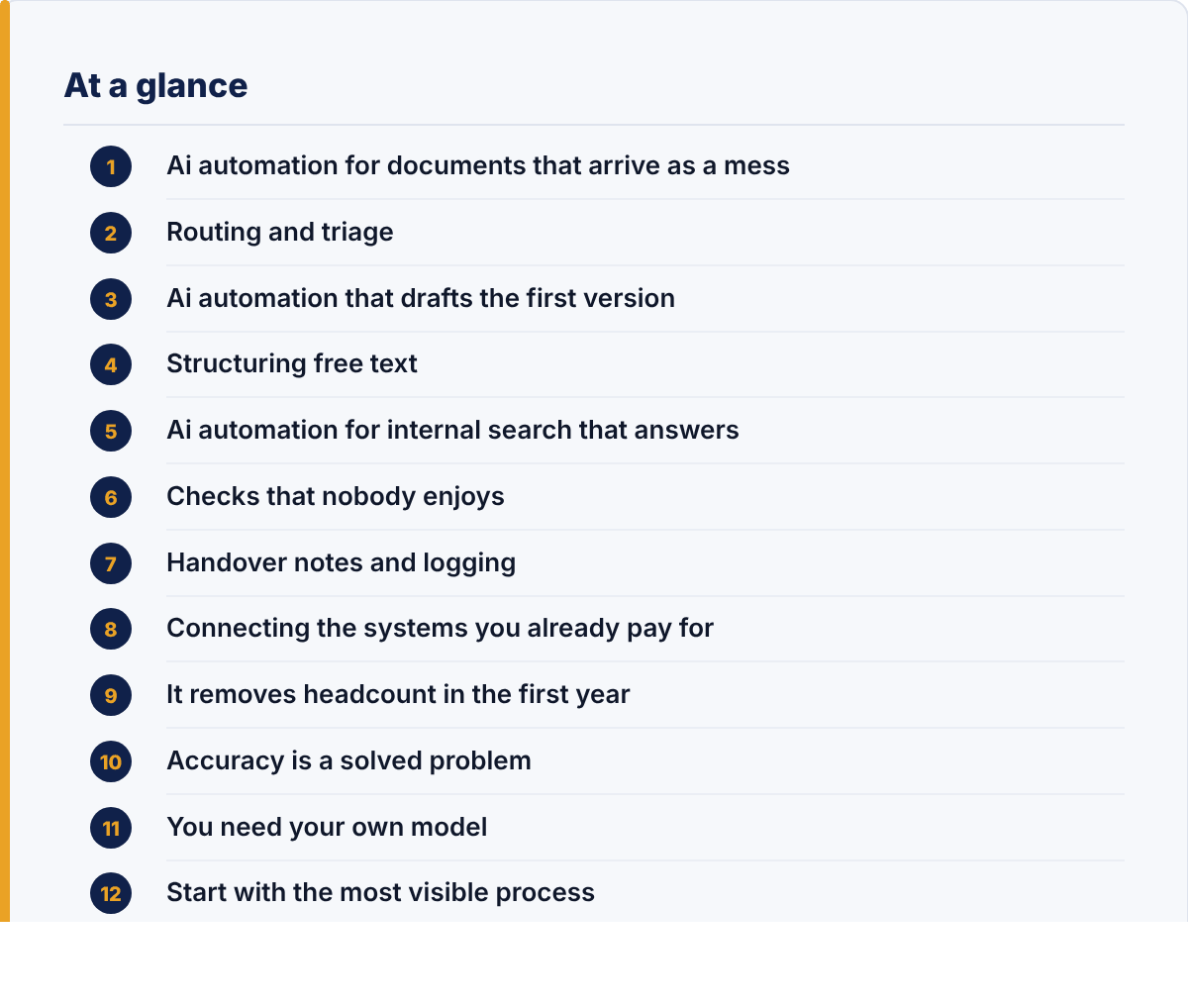
1. Ai automation for documents that arrive as a mess
Invoices, purchase orders, delivery notes and forms in twelve different layouts. This used to be a project; now it is a short piece of work with a review step, and the saving is immediate because the task was pure transcription.
2. Routing and triage
Sorting inbound email or tickets into the right queue with the right priority. The model does not need to be right every time, since the fallback is the queue the item would have sat in anyway.
3. Ai automation that drafts the first version
Replies, summaries, job descriptions, product copy. A human still edits, so the gain is in the blank page rather than the final text, and that is still a real gain.
4. Structuring free text
Turning call notes, survey answers or reviews into fields you can filter. This is dull and it is where a lot of quiet value sits, because the data existed and was simply unusable.
5. Ai automation for internal search that answers
Pointing a model at your own documents so staff get an answer with a citation rather than a list of files. Insist on the citation, otherwise you cannot tell a good answer from a confident one.
6. Checks that nobody enjoys
Comparing a contract against a checklist, or flagging anomalies in a report before a human reviews it. Framed as a second pair of eyes rather than a decision maker, this works well.
7. Handover notes and logging
Summarising what happened on an account or a shift, so the next person starts informed. Small, and it compounds.
8. Connecting the systems you already pay for
Much of what gets sold as ai automation is ordinary integration work with a model doing one step in the middle. That is not a criticism, because the integration is usually where the value was.
Four ai automation myths that waste budget
1. It removes headcount in the first year
Ai automation removes tasks. Those tasks are spread across people, so the effect shows up as capacity rather than as a smaller payroll, and anyone promising otherwise is selling.
2. Accuracy is a solved problem
It is not, so design ai automation for being wrong. Every workflow needs a review step, a confidence threshold or a reversible action. The United States National Institute of Standards and Technology’s AI Risk Management Framework is a practical starting point for deciding how much review a given task needs.
3. You need your own model
Almost nobody does. The ai automation work that matters is in the data you feed it, the prompt, and the handling of failures, none of which requires training anything.
4. Start with the most visible process
Tempting and usually wrong. Start with something low risk, high volume and easy to check, because the first project teaches you how to run the second one, and you want that lesson to be cheap.

Ai automation questions we get asked most
Where should a first ai automation project start?
With a task that is high volume, low risk and easy to check, because the point of the first project is to learn how your organisation reviews and corrects machine output. Companies that begin with something customer-facing learn the same lesson at a much higher price.
Does ai automation need clean data?
Less than it used to, which is most of what changed. Handling inconsistent documents is now one of the things it does well. What it still needs is a clear definition of a correct result.
How is ai automation different from the automation we already have?
Rules-based automation does exactly what you specified. Ai automation handles the steps where the rule could not be written down, and in exchange it is occasionally wrong, so it belongs behind a review step.
How to pick the first one
Good ai automation starts small. Find a task done more than fifty times a week, where a wrong answer is visible and cheap to fix, and where someone can tell you today what “correct” looks like. If no task meets all three, the right first step is measurement rather than automation.
Our AI and automation page sets out how we scope these, and the API integration page covers the plumbing that most of this work turns out to be.
Leave a Reply