Choosing a shopify development partner is mostly a question about restraint. The platform does a great deal out of the box, and the agencies that produce the best results are usually the ones arguing for less custom work rather than more.
Here are eight questions that surface how a shopify development partner actually thinks.
1. What would the shopify development partner refuse to build?
A good shopify development partner answer is specific and slightly deflating: a custom checkout you do not need, a bespoke feature an existing app covers, a redesign when the problem is page speed. An agency that agrees to everything is quoting rather than advising.
2. Theme customisation or a custom build, and why?
Most stores are well served by a solid theme carefully customised, since it keeps you compatible with updates and with the wider app ecosystem. A fully custom front end makes sense at real scale or where the shopping experience is genuinely unusual. Ask which they are proposing and what it costs you in flexibility later.
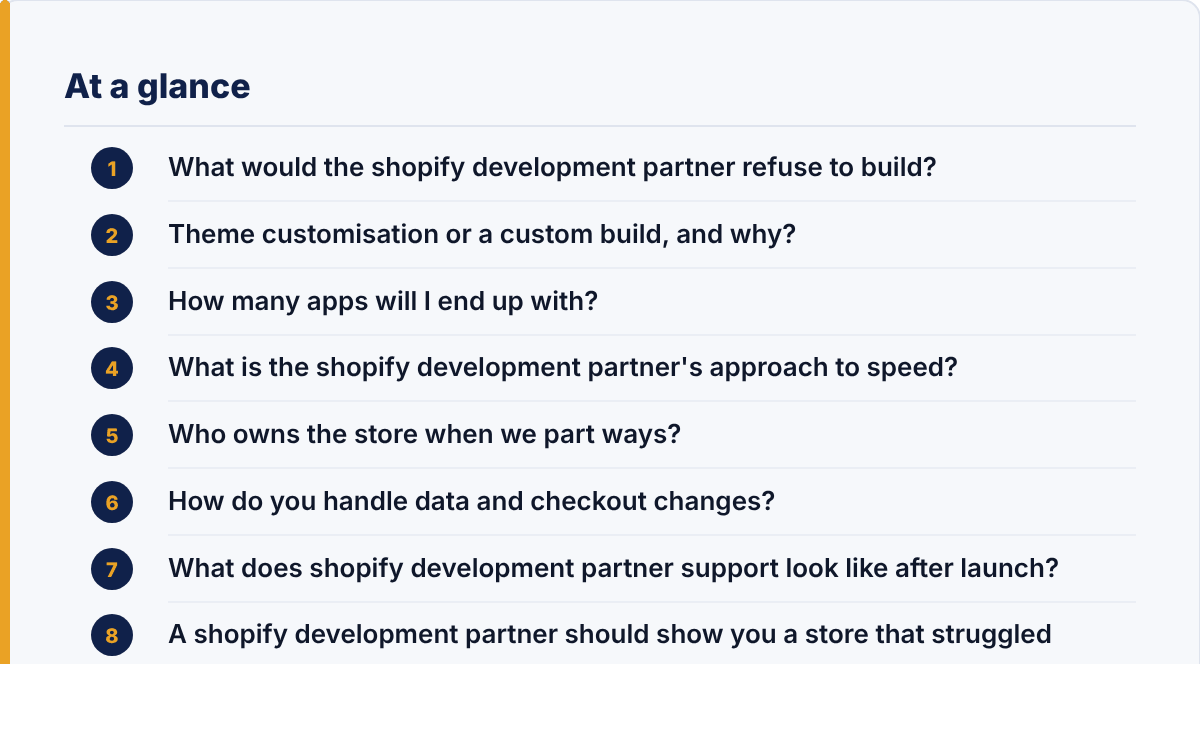
3. How many apps will I end up with?
Apps are the quickest route to a feature and the most common cause of a slow, fragile store. Each one adds scripts, a monthly fee and another thing that can break during a platform update. Ask how they decide between an app and building something small, and ask who audits the list annually.
4. What is the shopify development partner’s approach to speed?
Ask for a live store they built and check it yourself on a phone, on mobile data. Google’s page experience documentation explains what is being measured, though you will notice a slow store without any of it. Conversion and speed move together more reliably than almost anything else on a store.
5. Who owns the store when we part ways?
You should own the Shopify account, the theme code, the domain and any custom app. Ask for that in writing. Ask too whether the theme lives in a repository you can access, because a theme edited only in the admin has no history and no way back from a bad change.
6. How do you handle data and checkout changes?
Customer data, abandoned cart flows and anything touching checkout carry obligations and platform restrictions. A partner who has worked at any scale will raise this unprompted, including what is and is not permitted outside the enterprise plan.
7. What does shopify development partner support look like after launch?
Stores break on Black Friday, not on a quiet Tuesday. Ask about response times, who is on call, and what counts as included versus billable. Then ask what they charge for an urgent fix outside hours, because the answer tells you how they think about the relationship.
8. A shopify development partner should show you a store that struggled
Every shopify development partner has one that underperformed. What you are testing is whether they can say what went wrong and what they changed. An agency with only successes is either very new or not going to be straight with you when it is your turn.
Shopify development partner questions we are asked
Does a shopify development partner need to be a Shopify Plus partner?
Only if you are on Plus or heading there. The badge indicates volume of work on the platform rather than quality of judgement, so use it as a filter and not as the decision.
What should a shopify development partner charge?
Theme customisation is a project of weeks; a custom front end is months and a different order of cost. Ask which is being proposed before comparing two numbers, because they are not the same purchase.
Can we change shopify development partner mid-build?
Yes, and it is far less painful where the theme lives in a repository you own and the store is in your own Shopify account. That is the real reason to insist on both at the start.
What usually matters more than the build
Pick your shopify development partner on judgement rather than on a feature list. Product photography, how clearly the pages answer buying questions, and how quickly the site loads on a phone. Those three move revenue more reliably than most custom development, and all three are cheaper than a rebuild. A partner who leads with them is telling you something useful about where they think the value is.
Our ecommerce development page sets out how we build and maintain stores, and the ecommerce growth page covers what we do once one is live.