Author: Sanjan Sharma

  • Public Relations Agency in Dubai: 7 Smart Questions

    Public Relations Agency in Dubai: 7 Smart Questions

    Choosing a public relations agency in Dubai is not the same exercise as choosing one in London or New York. The media landscape is smaller and more relationship-driven, a large share of the audience is expatriate and reads in English while a large share is not, and the rules on what you may claim in public are stricter than many arrivals expect.

    So the standard agency questions still apply, and these seven apply on top.

    1. Which newsrooms does the public relations agency in Dubai actually place in?

    Ask for titles, not tiers. The difference between a trade publication your buyers read and a listings site that republishes releases is enormous, and both can be described as coverage. Then ask when they last placed in each one, because relationships here go stale quickly as journalists move.

    2. Do you work in Arabic, or translate into it?

    These are different capabilities. Translated copy reads as translated, and Arabic-language outlets notice. If a meaningful part of your audience is regional rather than expatriate, ask who writes rather than who converts.
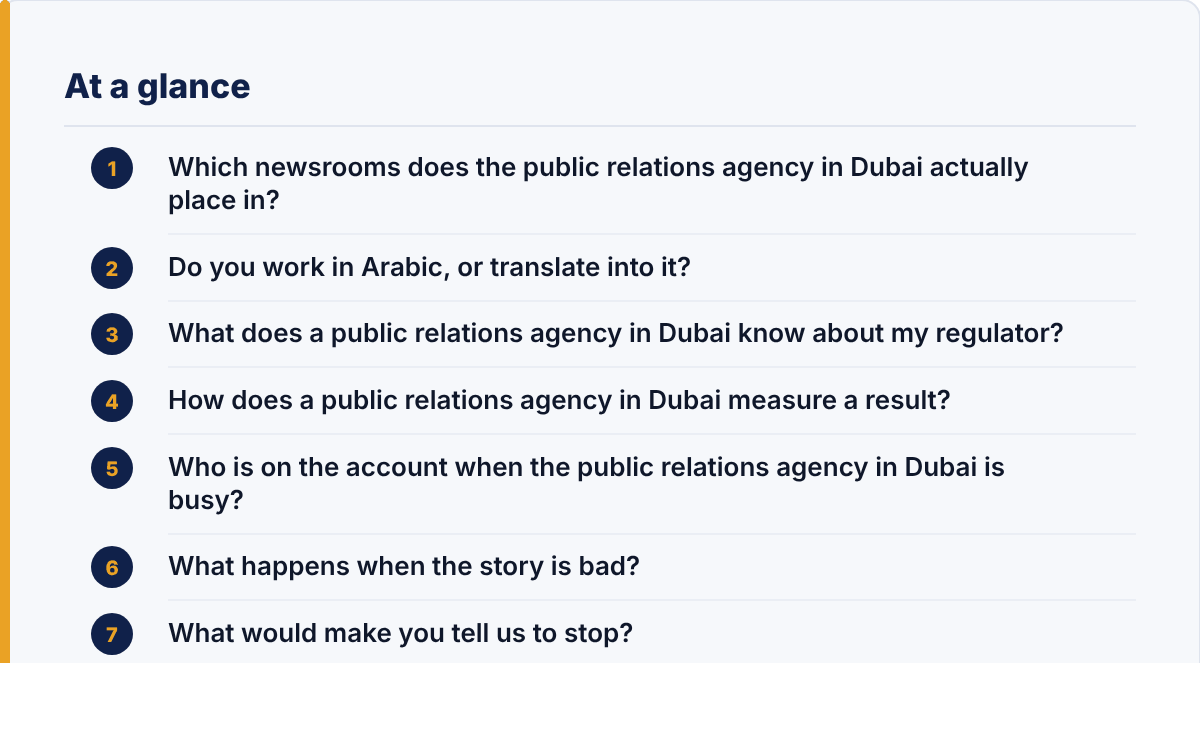
    public relations agency in dubai: the article's points at a glance

    3. What does a public relations agency in Dubai know about my regulator?

    Financial services, healthcare, education, property and crypto all sit under specific authorities here, and each constrains what you may say publicly. A public relations agency in Dubai that has worked in your sector will raise this before you do. One that has not will write something confident and leave you to discover the problem.

    4. How does a public relations agency in Dubai measure a result?

    Press clippings are not a result, although they are pleasant. Agree what the coverage is for: inbound enquiries, investor confidence, recruitment, or simply being credible when someone searches your name before a meeting. Then agree which system records it.

    Advertising value equivalence is still quoted in this market. Treat it as a vanity figure, because it measures what the space would have cost rather than what the coverage achieved.

    5. Who is on the account when the public relations agency in Dubai is busy?

    A public relations agency in Dubai scales up and down fast, and senior people appear at pitches more reliably than on accounts. Ask for names, how many clients each carries, and who writes the first draft. Then ask who you call on a Friday, which is a weekend day here and the detail most people forget.

    6. What happens when the story is bad?

    Ask for a specific example. How quickly did they respond, who spoke, and what did they advise the client not to say? Crisis handling is the part of the work with the highest cost of getting wrong, and it is where experience is least fakeable.

    7. What would make you tell us to stop?

    A good answer involves a real threshold, such as a cost per qualified enquiry above which this channel does not make sense for you. A public relations agency in Dubai that cannot imagine recommending less is paid in a way that conflicts with your result.

    If you are new to operating here, the UAE government’s official guide to doing business in the UAE is a reasonable neutral starting point on the regulatory side.
    Seven questions to ask a public relations agency in Dubai before signing
    The market is small enough that relationships are the product.

    What people ask before hiring here

    What does a public relations agency in Dubai charge?

    Monthly retainers are the norm and the spread is wide, because the same label covers media relations only and covers a full programme with events, spokesperson training and crisis cover. Ask which of those the fee includes before comparing two numbers.

    Do I need a local agency, or will a global one do?

    For regional coverage, a public relations agency in Dubai with current newsroom relationships will outperform a global network servicing the market from elsewhere. For international coverage the reverse often holds, and plenty of companies run both.

    How quickly can a public relations agency in Dubai get coverage?

    Faster than in larger markets, if the story is genuinely newsworthy. Weeks rather than months is realistic, which is also why a thin story gets found out quickly here.

    What is genuinely different about this market

    Three things, in our experience. Coverage arrives faster than in larger markets because the pool of outlets is smaller and the relationships are closer. Events and speaking slots do more work here than they do elsewhere. And the gap between a well-connected agency and a poorly connected one is wider, since there is less of a long tail of publications to fall back on.

    If you want to see how we work in the region, our public relations page sets out the process, and our Dubai page covers what we do locally.
  • Online Reputation Management: 8 Hard, Practical Rules

    Online Reputation Management: 8 Hard, Practical Rules

    Most people discover online reputation management on a bad morning. Something unflattering is on page one, a review is sitting there at one star, or a former employee has written a thread. The instinct is to get it taken down, and that instinct is usually the expensive one.

    Here is how this actually works, including the parts nobody selling it enjoys explaining.

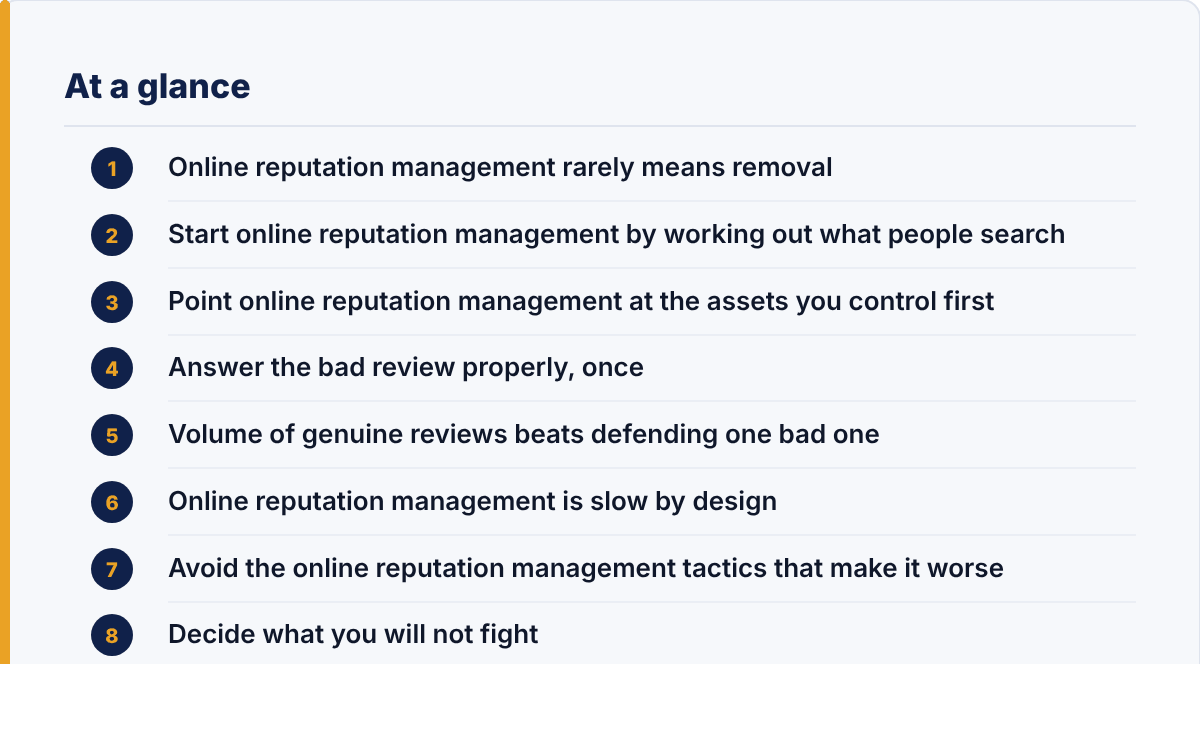
    1. Online reputation management rarely means removal

    Lawful, accurate content generally stays up. Platforms remove things that break their rules, and search engines de-index very little. So the realistic goal is almost always to change what dominates the first page rather than to erase what is on it.

    Anyone promising guaranteed removal is either describing a narrow legal case or is not being straight with you.

    2. Start online reputation management by working out what people search

    Your brand name, your founder’s name, and the combinations with “reviews”, “complaints” or “scam” attached. Check each one from a logged-out browser, because your own results are personalised and will quietly reassure you.

    online reputation management: the article's points at a glance

    3. Point online reputation management at the assets you control first

    Your site, your profiles, your directory listings and your social accounts are pages you can improve immediately, and they are the cheapest way to fill the first page with things you wrote. This is unglamorous and it is most of the work.

    4. Answer the bad review properly, once

    A short, specific, non-defensive reply does more for the next reader than for the person complaining. Acknowledge the facts, say what changed, and offer to continue elsewhere. Then stop, because an argument that continues publicly is a worse result than the original review.

    5. Volume of genuine reviews beats defending one bad one

    Most online reputation management effort is misplaced here. One angry review among six is damaging; among two hundred it is ordinary and even useful, since a perfect score reads as fake. So the most effective reputation work is often just asking satisfied customers at the right moment. Never incentivise a rating, though, because platforms detect it and the penalty is worse than the problem.

    6. Online reputation management is slow by design

    Search results move over months, not days. A new page needs to be found, trusted and preferred before it displaces an older one, and nothing you buy changes that timeline. Budget on a six-month horizon and judge progress by what is appearing on page two.

    7. Avoid the online reputation management tactics that make it worse

    Fake reviews, mass takedown requests against lawful criticism, and legal threats against individuals all tend to create a second, larger story. The United States Federal Trade Commission’s guidance on endorsements and reviews sets out what is actually prohibited, and it is worth reading before anyone suggests being clever.

    8. Decide what you will not fight

    Some criticism is fair. Some is from a competitor and will never be removed. Some will be forgotten faster if ignored. Write down in advance which category a new item falls into, because that decision is much harder to make calmly at eight in the morning.

    Eight practical rules for online reputation management after a bad result
    Crowd out, do not take down. It is slower and it works.

    What to put in place before you need it

    Claim every profile that carries your name, even the ones you do not use, because an unclaimed listing is the one that ranks awkwardly later. Keep a simple document of who responds, within what time, and who signs off anything legal. Good online reputation management is mostly having decided these things on a quiet day.

    Online reputation management questions we get asked

    How much does online reputation management cost?

    It depends almost entirely on whether you need publishing or defending. Claiming profiles and improving pages you already own is modest and mostly one-off. Displacing an established negative result on a competitive brand name is a six-month programme, and online reputation management priced as a quick fix is usually selling takedown requests that will not succeed.

    Can online reputation management remove a Google result?

    Only where the content breaks a platform rule or a law. Otherwise the work is crowding it out, which is slower and considerably more reliable.

    Is online reputation management worth it for a small business?

    Yes, and the cheap version is most of the value: claim the listings, ask happy customers for reviews, reply to the unhappy ones once. That is online reputation management, and it costs attention rather than money.

    The short version

    Online reputation management is mostly publishing, answering and waiting. The firms that do it well spend their time building pages worth ranking, while the ones that do it badly spend yours on takedown requests that were never going to succeed.

    If you want help with the publishing side, our digital PR page covers how we earn coverage that ranks, and our public relations page covers the handling of a story while it is live.

  • Best Web Design Company Website: 7 Honest Signals

    Best Web Design Company Website: 7 Honest Signals

    There is a useful shortcut when you are shortlisting agencies: judge them by their own site first. The best web design company website is not the prettiest one, it is the one that quietly demonstrates how the firm thinks, and a surprising amount is readable before you ever speak to anyone.

    Here are seven signals we look for on any best web design company website shortlist, including the ones that are uncomfortable to apply to ourselves.

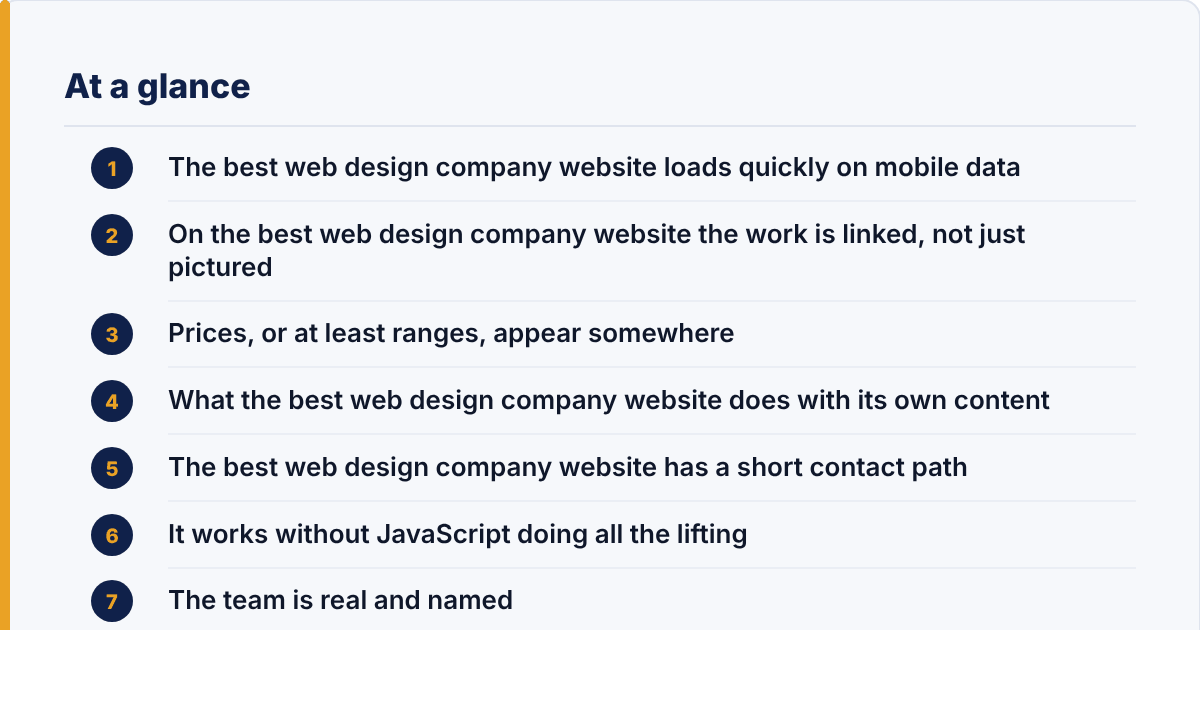
    1. The best web design company website loads quickly on mobile data

    Open it on your phone away from office wifi. If an agency’s own site takes six seconds and jumps around while it settles, that is what they consider acceptable, and you will be arguing about it later on your build. Google’s Core Web Vitals documentation explains what is being measured, although you do not need the detail to notice a slow page.

    2. On the best web design company website the work is linked, not just pictured

    Screenshots in a case study prove nothing, because anyone can design a page that was never built. Live links to shipped sites prove a great deal. If most of the portfolio is unlinked, ask why, since the usual honest answer is that the client relationship ended or the site has since been redesigned.

    best web design company website: the article's points at a glance

    3. Prices, or at least ranges, appear somewhere

    Not every firm can publish a price list, and that is fair. However, an agency that will not indicate a range anywhere is making you spend a call to find out whether you are in the right room at all. A starting figure is a courtesy, and it also signals confidence.

    4. What the best web design company website does with its own content

    Read two of their articles. Are they specific about decisions and trade-offs, or are they generic posts that could have been published by anyone? A firm that writes vaguely about its own craft will usually write vaguely in your project documentation too.

    We hold ourselves to this and it is harder than it sounds, because specific writing requires admitting what you got wrong.

    5. The best web design company website has a short contact path

    Count the clicks from the homepage to a way of reaching a human. Then count the fields in the form. An agency that asks for your budget, timeline, company size and job title before a conversation has designed that form for its own convenience, which tells you something about how they will approach yours.

    6. It works without JavaScript doing all the lifting

    Disable images, or simply resize the window narrow and wide. Good sites stay usable and readable; fragile ones collapse. This is a thirty-second test that surfaces a surprising amount about engineering discipline.

    7. The team is real and named

    Named people with real roles, and ideally the ones you will actually work with. Stock photography and a generic “our team” paragraph are not disqualifying on their own, although combined with an unlinked portfolio they form a pattern worth asking about.

    How to use these seven in an hour

    Take your shortlist and run the same checks in the same order on each best web design company website candidate, writing one line per signal. The point is not to find a perfect score, since nobody has one. The point is that the pattern of what each firm neglects is remarkably consistent with how they will run your project.

    Seven signals to look for on the best web design company website
    Their own site is the only work sample you can inspect for free.

    Questions people ask when shortlisting on this basis

    Does the best web design company website have to be beautiful?

    No, and the correlation is weaker than you would expect. Plenty of award-winning sites are slow, fragile and hostile to contact. The best web design company website is the one whose choices you would be happy to inherit on your own project.

    Should an agency’s own site use the stack they would sell me?

    Ask, because the answer is informative either way. A firm running something different from what it recommends may have a good reason, and it may also be a sign that the recommendation is about margin.

    What if the best web design company website on my shortlist is also the most expensive?

    That is common and not a reason to discount it. Compare what the fee includes, since a build that comes with analytics, accessibility and a handover is a different purchase from one that comes with files.

    What this shortcut cannot tell you

    It cannot tell you whether they hit deadlines, how they behave when a project goes sideways, or whether they will still answer in month nine. Those come from references and from asking to speak to a client who left, so treat the site as a filter rather than a verdict.

    If you want to apply all seven to us, start with our website development page, then look at the portfolio and check how many of those links actually open.

  • Thought Leadership: 8 Real Rules That Avoid Noise

    Thought Leadership: 8 Real Rules That Avoid Noise

    Most thought leadership is ordinary content wearing a better job title. It summarises what the industry already agrees on, adds a statistic, and ends with a call to action. Nobody argues with it, nobody remembers it, and the person who wrote it quietly suspects as much.

    The version of thought leadership that works is uncomfortable to write, because it requires saying something that could turn out to be wrong. Here are eight rules we hold ourselves to.

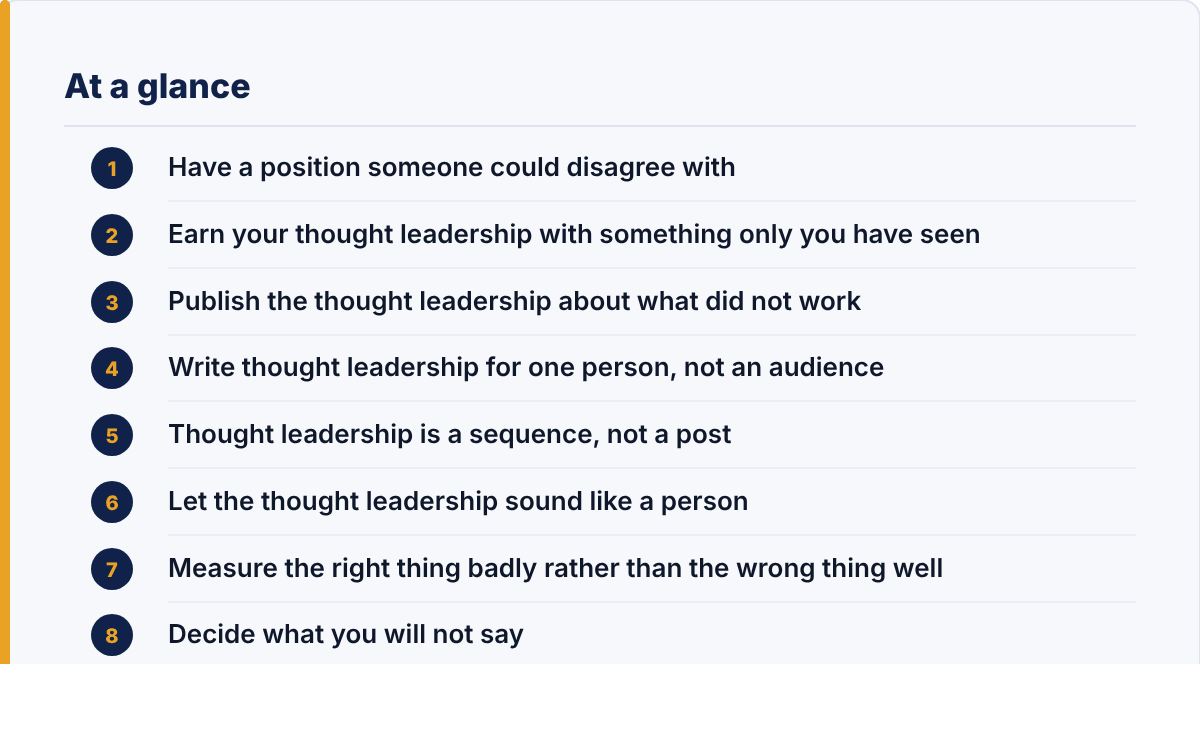
    1. Have a position someone could disagree with

    If every reasonable person in your field would nod along, you have written a summary. A position has an opposite that is also defensible, so start by asking what you believe that a competent competitor does not. That sentence is the piece; everything else is support.

    2. Earn your thought leadership with something only you have seen

    Opinion without evidence is just confidence. The evidence does not need to be a dataset, although it helps. It can be a pattern across the last thirty clients, a decision that went badly, or a number from your own dashboard.

    When we write about outbound, we use our own accounts: 5,076 LinkedIn invitations produced 1,086 replies and 370 booked sales calls. The numbers matter less than the fact that they are ours and can be checked.

    thought leadership: the article's points at a glance

    3. Publish the thought leadership about what did not work

    This is the fastest credibility there is, and almost nobody does it. A post about a campaign that underperformed and why teaches more than three about success, because failure has specific causes while success has flattering ones.

    4. Write thought leadership for one person, not an audience

    Picture a specific buyer with a specific problem on a specific Tuesday. Then write to them. Content addressed to everyone reads as though it was written by a committee, which it often was.

    5. Thought leadership is a sequence, not a post

    One good piece of thought leadership changes nothing. The effect comes from returning to the same two or three arguments for a year, from different angles, until people associate the idea with you. So pick the arguments deliberately and be willing to be slightly repetitive, because you are far more bored of them than your reader is.

    6. Let the thought leadership sound like a person

    Committee review sands the edges off, and the edges were the point. If the founder said something sharp in the interview, keep it. Approval processes that remove every strong sentence produce safe pieces that nobody finishes.

    7. Measure the right thing badly rather than the wrong thing well

    Views are easy to count and tell you almost nothing. Better signals are messier: who replied, who mentioned the piece on a sales call, which argument came back to you from a stranger. Keep a simple note of those, since no dashboard will do it for you.

    8. Decide what you will not say

    Every real thought leadership position has a cost, so work out in advance which clients it might lose you and whether you accept that. The Content Marketing Institute’s research on what buyers actually value in thought leadership is a useful outside check if you want to sanity-test your assumptions first.

    Eight rules for thought leadership that readers remember and forward
    A position someone could argue with is the whole requirement.

    Thought leadership questions founders ask us

    How often should thought leadership be published?

    Less often than most calendars assume, and far more consistently. One substantial piece a month that advances the same argument beats weekly posts that advance nothing, because thought leadership compounds through repetition of an idea rather than volume of output.

    Can thought leadership be ghostwritten?

    The writing can. The position cannot. If the founder has not said the uncomfortable sentence out loud to a writer, the result will be competent and forgettable, which is the failure mode this whole article is about.

    How do you know thought leadership is working?

    When your argument comes back to you from someone you never spoke to. That is the signal, and no dashboard reports it.

    The short version

    Thought leadership is not a content format, it is a willingness to be specific in public. If a piece could have been published by three of your competitors with the logo swapped, then it is marketing, and that is fine, but it will not do this job.

    If you want help building the sequence, our founder thought leadership page sets out how we work with founders, and the four-account case study is the evidence behind the figures above.

  • Mobile App Development: 9 Costly, Hidden Mistakes

    Mobile App Development: 9 Costly, Hidden Mistakes

    Most mobile app development projects do not fail dramatically. They go over budget quietly, ship late, launch to very few downloads, and then sit there costing money in maintenance while everyone politely avoids the subject. The causes repeat, which is the useful part, because a repeating mistake is one you can decide about in advance.

    Here are nine mobile app development mistakes we see most often, roughly in the order they bite.

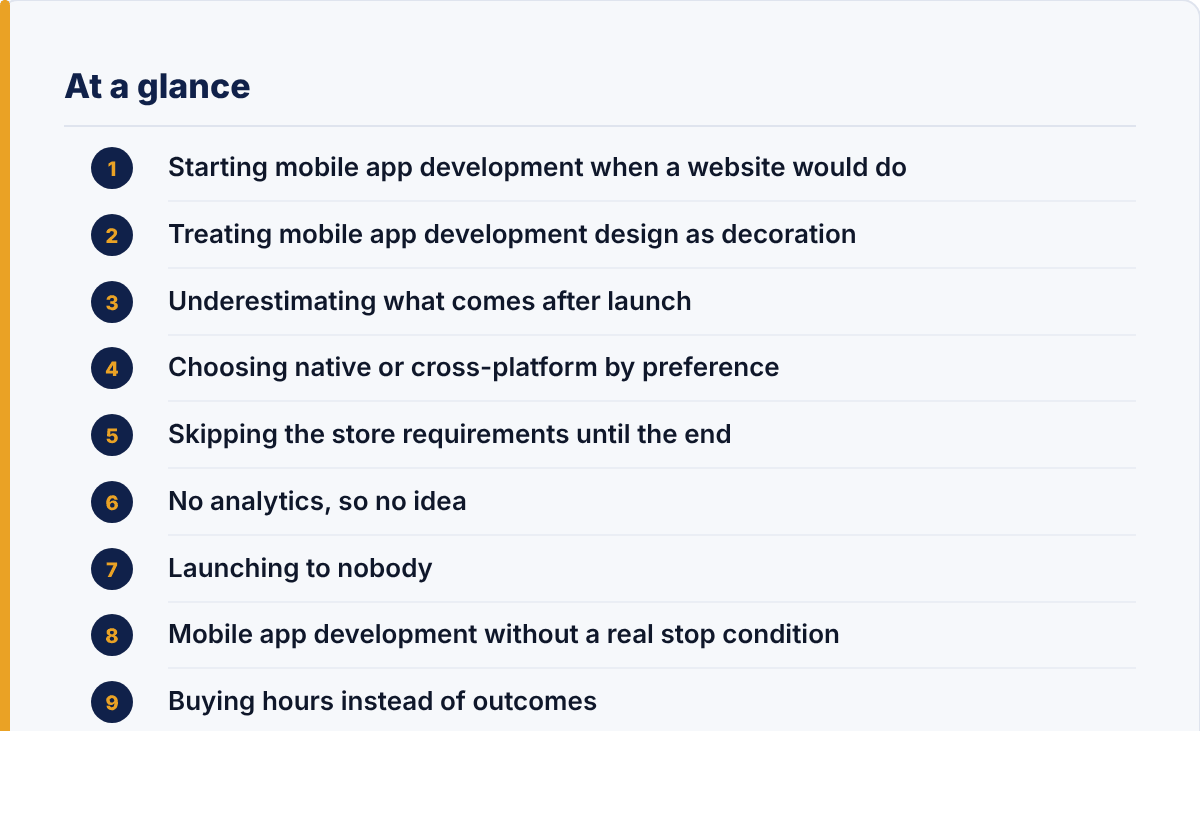
    1. Starting mobile app development when a website would do

    The first question is whether this needs to be an app at all. If people will use it once a month, a fast mobile website is usually better, because it costs less, updates instantly and requires no download. Apps earn their place through frequency, offline use, notifications or hardware access. If none of those apply, you are paying for an icon on a screen nobody taps.

    2. Treating mobile app development design as decoration

    Screens get signed off because they look good, not because anyone walked through the actual task. Then the build begins and the gaps appear: the empty state nobody drew, the error message nobody wrote, the step that needs a confirmation. Each one is a small decision made late, and late decisions are the expensive kind.

    mobile app development: the article's points at a glance

    3. Underestimating what comes after launch

    This is the biggest hidden cost in mobile app development. Both platforms update yearly, devices change, libraries deprecate, and an app left alone for eighteen months often will not build, let alone run. Budget for maintenance from the start, because an app is a commitment rather than a purchase.

    4. Choosing native or cross-platform by preference

    Neither approach to mobile app development is correct in general, although one is usually correct for you. Cross-platform suits apps that are mostly screens, forms and data. Native earns its extra cost when you lean hard on the camera, background processing, Bluetooth or heavy graphics. Decide from your feature list rather than from a developer’s comfort zone.

    5. Skipping the store requirements until the end

    Review rejections are ordinary and recoverable, but they are much cheaper to avoid. Account deletion, privacy labels, permission explanations and payment rules all shape the build. Apple’s App Store Review Guidelines are readable in an afternoon, and reading them before the architecture is set saves rework afterwards.

    6. No analytics, so no idea

    Teams finish mobile app development having instrumented downloads and nothing else. Then the app underperforms and nobody can say where people stop, because the funnel was never recorded. Decide the three events that mean the product is working, and have them in the first release rather than the third.

    7. Launching to nobody

    An app store is not a marketing channel. Nothing arrives on its own, so the launch plan has to exist before the build finishes, and it usually involves the audience you already reach. This is the point where a lot of good products stall.

    8. Mobile app development without a real stop condition

    Agree in advance what would make you stop investing, and write the number down while nobody is attached to the outcome. Otherwise version two gets funded out of hope, and the budget disappears in increments nobody individually objects to.

    9. Buying hours instead of outcomes

    Fixed-scope mobile app development with vague acceptance criteria produces arguments. So does an open-ended rate card with no checkpoints. The workable middle is a short discovery phase that produces a specification you both agree on, then build phases with something demonstrable at the end of each one.

    Nine common mobile app development mistakes and what each one costs
    Most of these are decisions, not accidents.

    Mobile app development questions we answer most weeks

    How much does mobile app development cost?

    The honest answer is that the range is so wide the number is meaningless without a feature list. What moves it most is not the screen count but the integrations, the compliance requirements and whether anything has to work offline, so scope those three before asking anyone for a figure.

    How long does mobile app development take?

    A focused first version is usually measured in months rather than weeks, and the part people underestimate is review, store setup and the fixes that follow real users. Build the plan backwards from a launch date you can defend.

    Can mobile app development be done without a designer?

    It can, and it usually costs more. The empty states, errors and confirmations that a designer settles on paper get settled during the build instead, by developers, one expensive decision at a time.

    What to settle before you spend anything

    Three things, and they take a week rather than a quarter. What single task the app must make easier, how you will know within sixty days whether it does, and who maintains it in year two. Projects that answer those tend to survive; projects that start with a feature list tend to grow one.

    If you want to see how we scope this, our mobile app development page sets out the phases and what each one produces, and our UI and UX design page covers the walkthrough step that catches most of the gaps above.

  • Nearshore Software Development Company: 6 Hard, Real Truths

    Nearshore Software Development Company: 6 Hard, Real Truths

    Picking a nearshore software development company is usually a decision about time zones that turns out to be a decision about communication. The pitch is simple enough: similar working hours, lower cost than hiring locally, easier to reach than a team twelve hours away. All of that can be true, and none of it is the thing that decides whether the project works.

    We build software and we also buy it, so we have been on both sides of the nearshore software development company question. Here is what we would want settled first.

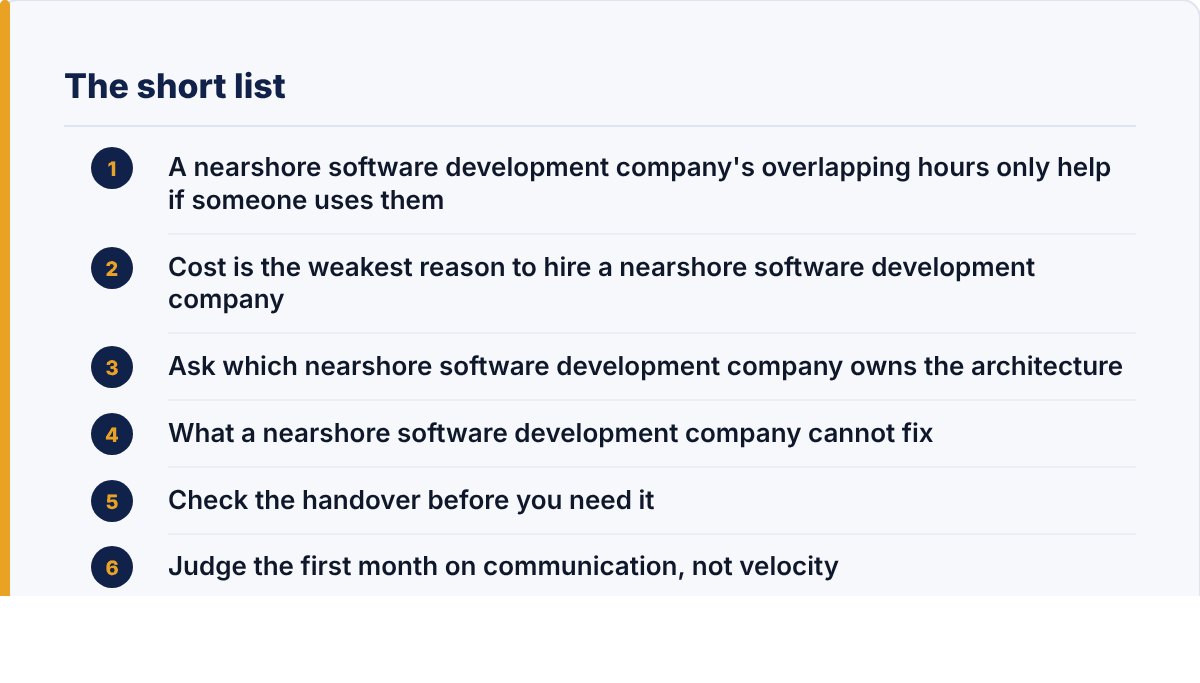
    1. A nearshore software development company’s overlapping hours only help if someone uses them

    Four shared hours a day is the usual selling point, and it is genuinely valuable. However, it only pays off if those hours are spent on decisions rather than status updates. A daily call where someone reads out a task board is not collaboration, it is a report delivered expensively.

    So ask how the overlap is actually used, and ask who is expected to be in it on your side. A nearshore software development company stalls for the same reason local ones do, which is that a question sat unanswered for a day.

    2. Cost is the weakest reason to hire a nearshore software development company

    If the only argument is the rate, the maths usually disappoints. Rework, longer ramp-up and the management time you now spend coordinating all eat the difference. The strong arguments are different: you can start in weeks rather than months, you can scale back down without a redundancy process, and you get specialists you could not justify hiring full time.

    nearshore software development company: the article's points at a glance

    3. Ask which nearshore software development company owns the architecture

    This is where projects quietly go wrong. If the vendor owns every architectural decision and you own none, then you have bought a black box that only they can maintain. If you own all of them and they own none, you have bought typists.

    The workable answer is usually that they propose and you approve, with the reasoning written down somewhere you can read later. Ask to see a decision record from another project.

    4. What a nearshore software development company cannot fix

    It cannot decide what the product should do. Unclear requirements do not become clear by being sent abroad, and in fact distance makes vague specifications more expensive, because the gap between what you meant and what was built takes longer to surface.

    So if the brief is still forming, pay for a short discovery phase before the build. It feels like a delay and it is almost always cheaper than the alternative.

    5. Check the handover before you need it

    Ask what you receive if the engagement ends badly. Repository access, infrastructure credentials, documentation, build instructions, and the right to the code in writing. Agree it at the start, because nobody negotiates this well once the relationship has soured.

    Then test it once, early. Have your own developer clone the repository and run the project from the written instructions. If that takes a week, you have found something worth knowing while it is still cheap.

    6. Judge the first month on communication, not velocity

    Early velocity numbers tell you almost nothing, since the team is still learning your domain. What tells you a great deal is how they behave when something is unclear. Do they ask, or do they guess and carry on? Do problems arrive early and small, or late and large?

    For the contractual side of all this, the World Intellectual Property Organization’s notes on software and intellectual property are a reasonable neutral starting point before your lawyer sees the agreement.

    Checklist for evaluating a nearshore software development company before signing
    Time zones are the easy part. Decision-making is the hard part.

    What people ask us about nearshore software development

    How is a nearshore software development company different from an offshore one?

    Distance, and therefore working hours. A nearshore software development company sits within a few hours of your time zone, so questions get answered the same day. Offshore is cheaper per hour and slower per decision, and which of those costs you more depends entirely on how settled your requirements are.

    What size team should a nearshore software development company start with?

    Smaller than you expect. Two or three engineers and a lead for the first six weeks is enough to prove the working relationship, and scaling a team that already communicates well is far easier than fixing a large one that does not.

    Who owns the code a nearshore software development company writes?

    You should, in writing, from day one, with repository and infrastructure access in your own accounts rather than theirs. This is cheap to agree at the start and close to impossible to agree at the end.

    The short version

    A nearshore software development company works when you already know what you want built and need capable hands in roughly your working day. It struggles when it is used to outsource the thinking, because that is the one thing distance makes harder rather than easier.

    If you want to see how we run a build, our custom software development page sets out the sequence, and our approach page explains how we handle the decisions you will be asked to make.

  • Healthcare SEO Agency: 7 Hard, Honest Questions

    Healthcare SEO Agency: 7 Hard, Honest Questions

    Hiring a healthcare SEO agency is not the same decision as hiring an SEO agency that happens to have taken a clinic as a client. Health content sits in the category Google treats most carefully, your marketing is regulated, and a page that ranks beautifully can still put you in front of your compliance officer. So the questions worth asking are different.

    Here are seven we would want asked of any healthcare SEO agency, our own included. None of them are clever. They are simply hard to answer unless the agency has done this work before.

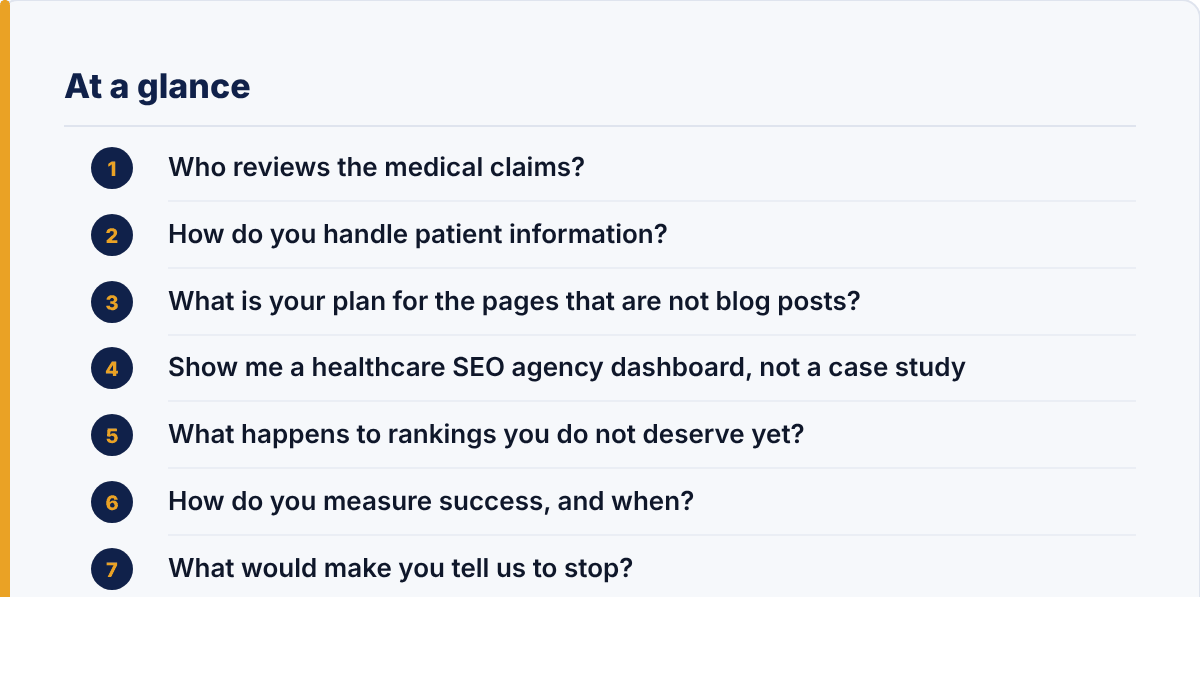
    1. Who reviews the medical claims?

    Ask for the name and the credential. A healthcare SEO agency that writes about symptoms, treatments or outcomes needs a clinician in the loop, and if the answer is that the writers research carefully, then the review step does not exist. You will be the one explaining that to a regulator, not them.

    The better answer names a process: who drafts, who reviews, what gets escalated, and where the sign-off is recorded.

    2. How do you handle patient information?

    Marketing touches more protected data than people expect. Call tracking, form fills, chat transcripts, analytics, review responses and retargeting pixels can all end up carrying something they should not. The United States Department of Health and Human Services publishes clear guidance on HIPAA and marketing, and a healthcare SEO agency working in this space should be able to discuss it without looking it up.

    If they have never configured analytics to exclude identifiers, that is a gap you will inherit.

    healthcare seo agency: the article's points at a glance

    3. What is your plan for the pages that are not blog posts?

    Most healthcare search is local and transactional. Someone wants a dermatologist near them who takes their insurance and has an appointment this week. That intent is served by location pages, service pages, provider profiles and your business listing, not by an article about skin types.

    Content still matters, although it works best as support. An agency that leads with a content calendar and says little about the pages people actually convert on has the priority backwards.

    4. Show me a healthcare SEO agency dashboard, not a case study

    A case study is a story the agency wrote about itself. A dashboard is the system of record, so ask to see the real screen: the search console property, the call tracking, the booking data.

    We publish dashboard walkthroughs of our own outbound work for exactly this reason. Across four accounts, 5,076 LinkedIn invitations produced 1,086 replies and 370 booked sales calls, and anyone can watch where each figure comes from. The channel is different, but the principle holds: if the screen cannot be shown, ask why.

    5. What happens to rankings you do not deserve yet?

    This is the uncomfortable one. A new practice site will not outrank a hospital system for a competitive treatment term in six months, however good the content is. An honest agency says so and redirects the effort somewhere winnable, such as specific procedures, specific neighbourhoods and the questions patients ask before booking.

    A healthcare SEO agency that promises the hard term anyway is either inexperienced or planning to show you a different metric later.

    6. How do you measure success, and when?

    Agree the definition before anyone reports against it. A ranking is not a result and traffic is not a result, because a booked appointment is. Decide which system holds that number, and decide who is allowed to mark a call as qualified.

    Agree the lag too. Search work compounds slowly, so the first ninety days should be judged on whether the right things were fixed rather than on revenue.

    7. What would make you tell us to stop?

    The best answer is a real threshold: a cost per new patient above which this channel does not make sense for your practice. A healthcare SEO agency that cannot imagine recommending less is paid in a way that conflicts with your result.

    Checklist of seven questions to ask a healthcare SEO agency before hiring
    None of these are trick questions. They are just hard to fake.

    Healthcare SEO agency questions we get asked back

    Does a healthcare SEO agency need to be healthcare-only?

    No, and the exclusive ones are not automatically better. What matters is whether the healthcare SEO agency has a clinical reviewer, has configured analytics for protected data before, and can name the regulator it worries about. A generalist with those three is safer than a specialist without them.

    How long before a healthcare SEO agency shows results?

    Local visibility usually moves inside three months because listings, service pages and location pages are quick to fix. National rankings for treatment terms take considerably longer, so judge the first quarter on whether the right things were repaired.

    What should a healthcare SEO agency cost?

    Ask what the fee buys rather than what the fee is. A retainer that includes clinical review, local work and reporting is a different product from one that buys four articles a month, and comparing the two on price alone is how practices end up disappointed.

    What a healthcare SEO agency should tell you unprompted

    Three things, and you should be suspicious if none of them come up. That compliance review will slow publishing down. That local visibility will move before national rankings do. And that some of your competitors rank because they are older and larger, which is a reason to compete differently rather than harder.

    If you want to see how we work before deciding anything, our SEO and answer engine optimisation page sets out the sequence we follow, and the four-account case study has the recordings behind every number we quote.

  • Sales Outsourcing: 6 Hard, Honest Truths Before You Buy

    Sales Outsourcing: 6 Hard, Honest Truths Before You Buy

    Sales outsourcing gets sold as a shortcut past a hiring problem. You need pipeline, hiring a sales development rep takes three months and might not work, so you rent a team that already exists. The logic is sound, and it is also where most of the disappointment comes from, because renting a team does not rent you the thing that was actually missing.

    We run outbound for clients and for ourselves, so we see both sides of sales outsourcing. Here is what we would want to know before signing.

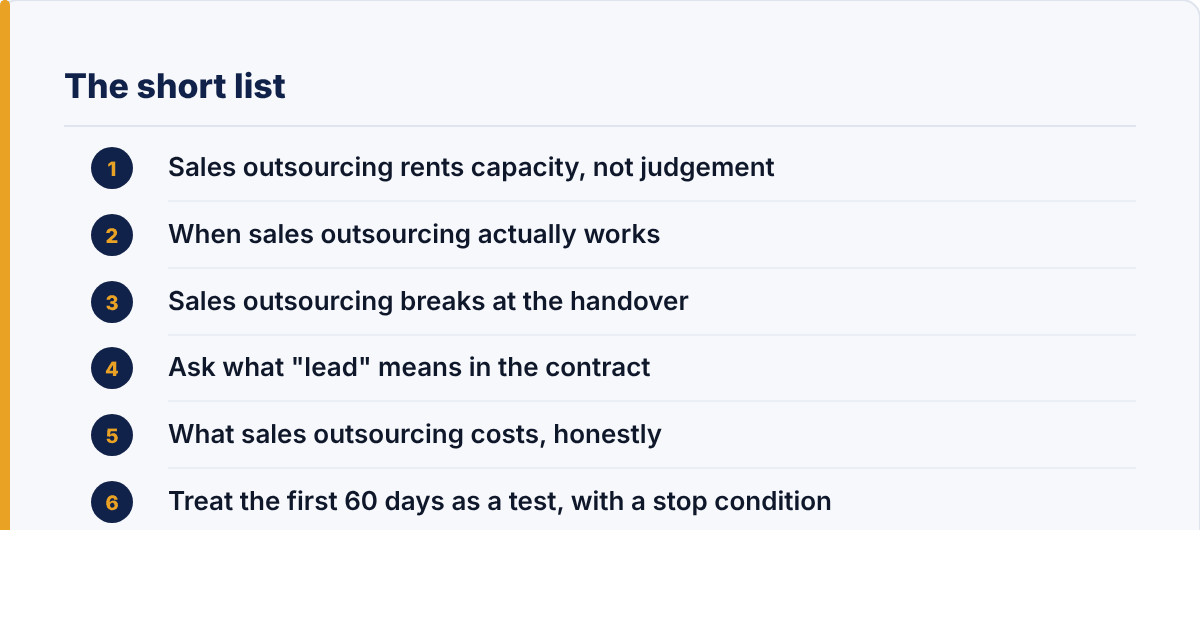
    1. Sales outsourcing rents capacity, not judgement

    An outsourced team can send volume, follow up reliably and book meetings. What it cannot do is decide who your best customer is, or work out why the last twenty deals stalled. That judgement sits with you, and if it does not exist yet, then outsourcing will produce busy, expensive activity pointed in a slightly wrong direction.

    So the honest test is whether you already know which segment converts. If you do, sales outsourcing scales it. If you do not, you are paying someone else to run your experiments at agency rates.

    2. When sales outsourcing actually works

    Sales outsourcing earns its money in three situations, in our experience. You have a proven offer and simply cannot generate enough conversations. You want to test a new market before committing headcount to it. Or your existing team closes well but hates prospecting, which is extremely common and rarely admitted.

    In all three the thing being bought is top-of-funnel volume against a known target. That is a narrow brief, and narrow briefs are the ones that succeed.

    sales outsourcing: the article's points at a glance

    3. Sales outsourcing breaks at the handover

    Most failures we see are not about message quality. A meeting gets booked, and then something goes wrong between the booking and the call: the calendar invite is vague, nobody confirms, your closer has not read the thread, and the prospect quietly disengages.

    We have had this on our own accounts. The reply rate looked fine while the booking rate did not, and the cause turned out to be the calendar step rather than the messaging. It took us longer to find than it should have, because everyone was looking at the copy.

    4. Ask what “lead” means in the contract

    This decides whether you will be satisfied. A form fill is not a lead. A booked call with someone who can sign is a lead. Agree it in writing, and agree what happens to a no-show, because the no-show rate is where optimistic reporting hides.

    For reference on how the volumes behave, our own four accounts sent 5,076 LinkedIn invitations, which produced 1,086 replies and 370 booked sales calls. Those are real numbers off real dashboards, and the useful thing about them is the shape: replies are plentiful and booked calls are not, so any proposal that implies otherwise is worth questioning.

    5. What sales outsourcing costs, honestly

    Priced per booked meeting, sales outsourcing usually looks expensive next to a salary and cheap next to a failed hire. That is the real comparison, and it is why the decision is less about rate cards than about your tolerance for a three-month hiring risk.

    The hidden cost of sales outsourcing is attention. Someone on your side has to review messaging, answer product questions and take the calls. Budget a few hours a week, because an outsourced team starved of input will fall back on generic copy, and then everyone blames the channel.

    6. Treat the first 60 days as a test, with a stop condition

    Agree in advance the cost per booked call above which sales outsourcing does not make sense for your business. Write the number down before the first message goes out, while nobody is emotionally invested.

    Then run it properly for sixty days. Shorter than that and you are measuring setup rather than performance, although longer than ninety without a stop condition is how budgets quietly disappear. The United States Small Business Administration’s guidance on marketing and selling is a reasonable neutral starting point if you want to sanity-check the basics first.

    Decision chart showing when sales outsourcing works and when to hire instead
    Outsourcing scales a proven offer. It does not discover one.

    Sales outsourcing questions we are asked most

    Is sales outsourcing cheaper than hiring?

    Per booked meeting it is usually more expensive than a productive in-house rep and considerably cheaper than an unproductive one. Since you cannot tell in advance which hire you are making, sales outsourcing is better understood as paying to remove a hiring risk than as paying less.

    Should sales outsourcing cover closing as well as prospecting?

    Rarely. The handover is already the weakest point, and closing on your behalf means an outside team explaining your product under pressure. Keep the close inside and buy the conversations.

    How long does sales outsourcing take to show results?

    First meetings inside a month if the targeting is settled, and a fair verdict at sixty days. Anything judged earlier is measuring setup.

    The short version

    Sales outsourcing is a capacity decision disguised as a strategy decision. If you know who buys and why, it is one of the faster ways to get more conversations. If you do not know that yet, then the money is better spent working it out, because no amount of outsourced volume will answer the question for you.

    If you want to see how we run it before deciding anything, the four-account case study has the dashboard recordings behind every figure, and our B2B lead generation page sets out the sequence we follow.

  • Business Process Automation: 7 Proven, Fast Wins

    Business Process Automation: 7 Proven, Fast Wins

    Most business process automation projects fail for a dull reason: they start with the most complicated process in the company. The invoice approval chain with nine exceptions. The onboarding flow that changes every quarter. Those are the processes people complain about, so they feel like the obvious place to begin, but they are the worst place to begin.

    The projects that pay back start somewhere unglamorous. A spreadsheet two people retype into another system. A folder of PDFs someone renames by hand every Friday. Work that is small, repetitive and never argued about. After eleven years of building software and marketing systems for more than 580 clients, that is the pattern we keep seeing, and it is the opposite of how most business process automation projects get scoped.

    What business process automation actually is

    It is handing a repeated, rule-based job to software so a person stops doing it by hand. That is the whole idea. It is not artificial intelligence, although AI can now handle steps that used to need a human eye, and it is not the same thing as buying a bigger platform.

    The distinction matters because the two get sold together. A new CRM is a place to put work. Business process automation is removing work. So you can buy the first and still have every one of your old problems, because nothing was actually taken off anybody’s desk.

    The seven business process automation wins that pay back fastest

    These are in rough order of how quickly we see them return the money, rather than how impressive they look in a slide.

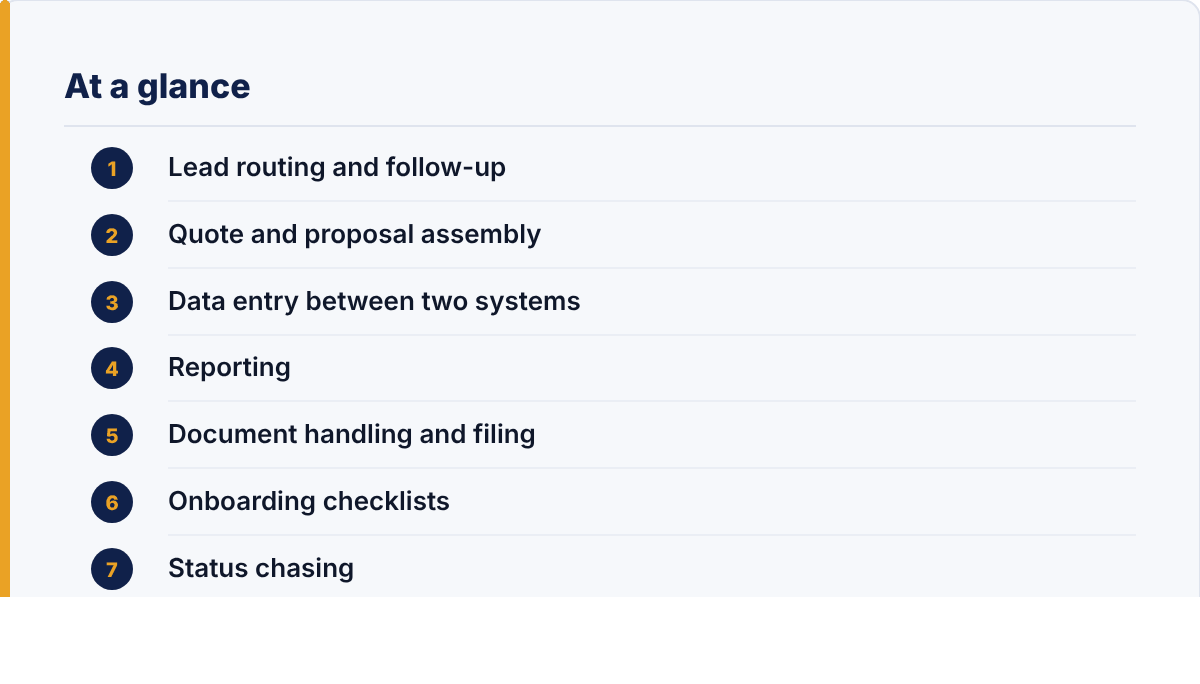
    1. Lead routing and follow-up

    A form fills in, and someone notices it four hours later. Automating the route, the first reply and the reminder chain is usually a day of configuration. We run our own outbound this way, and across 5,076 LinkedIn invitations it produced 1,086 replies and 370 booked sales calls, because nothing sat in an inbox waiting for a human to get around to it.

    2. Quote and proposal assembly

    If your proposals are a Word file someone copies and edits, then you are paying a salary to do find-and-replace. Pulling the client details, the scope and the pricing from one source and generating the document removes both the time and the typos.

    3. Data entry between two systems

    The classic. Orders in one place, accounts in another, and a person in the middle. This is the cheapest business process automation to build and the easiest to prove, so it makes a good first project even when it is not the most painful one.

    4. Reporting

    Someone spends Monday morning rebuilding the same report. The numbers already exist in the tools that hold them, so the report can assemble itself overnight. The time saved is real, but the bigger gain is that the report now arrives whether or not that person is on leave.

    5. Document handling and filing

    Renaming, sorting, extracting a few fields and filing them. This used to need a human because the documents were inconsistent. However, it mostly does not any more.

    6. Onboarding checklists

    Not the whole onboarding process, which is where people go wrong, but the checklist underneath it: the accounts to create, the access to grant, the reminders to send. The judgement stays human and the administration does not.

    7. Status chasing

    The messages that ask whether something has happened yet. If a system knows the answer, then it can send the update instead of a person asking for it. This one is usually dismissed as trivial, and yet it quietly consumes more management attention than anything else on this list.

    business process automation: the article's points at a glance

    Three traps that waste the budget

    Automating a process nobody has agreed on. If two people run the same job differently and both think they are right, business process automation does not resolve that. Instead it picks a winner and surprises everyone. So settle the process first, on paper, in an afternoon.

    Starting with the hardest process. The exception-heavy chain is where these projects go to die, because every exception becomes a branch, and then the branches become the project. Earn the credibility on three small jobs first.

    Buying the platform before scoping the work. Tool choice is the last decision, not the first. We build on whatever the business already runs well, and Zapier’s own guidance on mapping a process before you automate it is a reasonable free starting point if you want to do that mapping yourself.

    How to tell whether a process is worth business process automation

    Four questions, and you want a yes to all four. Does it happen at least weekly? Does it follow the same rules every time? Does everyone agree what those rules are? And would the output be checkable, so that a mistake would be noticed?

    A no to the second or third question means the process is not ready for business process automation yet. That is not a reason to abandon it, but the next step is then a conversation, not a build.

    What business process automation costs and how long it takes

    A single small business process automation build is days, not months. A connected set across one department is usually a few weeks. The reason these projects run to six months is almost always scope, because someone decided to fix the whole company at once.

    So the sequence we recommend is three small wins in the first month, measured honestly, and then a decision about the harder processes with real numbers in hand rather than a business case built on estimates.

    A business process automation map showing which repeated tasks to automate first
    Start with the small, repeated, uncontested jobs. The hard ones come third.

    Business process automation questions we get asked most

    Is business process automation the same as AI?

    No. Business process automation follows rules you define, and it is predictable for that reason. AI handles the steps where the rule cannot be written down, such as reading an inconsistent document, so the two sit side by side rather than replacing each other.

    How much business process automation can one team absorb at once?

    Three small builds in a month is comfortable. Beyond that the limit is not the software, it is how many changes to people’s daily habits the team can take at once, and that is the constraint most plans ignore.

    Does business process automation mean cutting jobs?

    In the work we do it has not, because the jobs that get automated are the ones nobody wanted: retyping, chasing, filing. The hours come back and get spent on work that needed a person all along.

    Where to start this week

    Pick the one job your team retypes most often, and time it honestly for a week. That number is your business process automation business case, and it is usually larger than anyone expected, because the cost of this work is spread thinly enough that nobody ever adds it up.

    If you want someone to do the mapping with you, then that is what our AI and automation team does, and you can also see how we run our own pipeline in the four-account outbound case study.

  • B2B Marketing Agency: Ask These 9 Hard, Honest Questions

    B2B Marketing Agency: Ask These 9 Hard, Honest Questions

    Hiring a b2b marketing agency is mostly an exercise in telling confident people apart. Everyone has a deck. Everyone has logos. Nearly everyone will tell you they are data-driven, and none of that distinguishes them, because it costs nothing to say.

    So here are nine questions we would want asked of us before you pick a b2b marketing agency. They are not clever gotchas. They are simply hard to answer well unless the agency has actually done the work, which is the whole point.

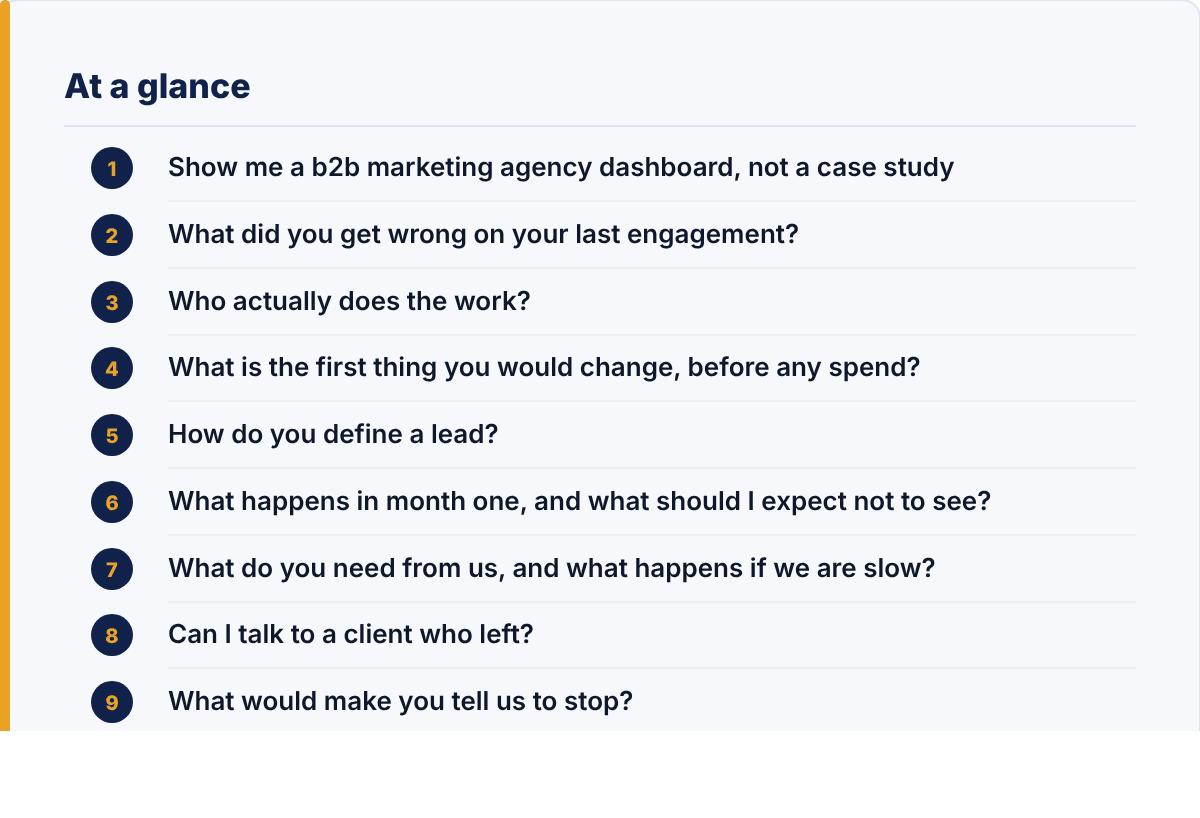
    1. Show me a b2b marketing agency dashboard, not a case study

    A case study is a story the agency wrote about itself. A dashboard is the system of record. Ask to see the actual platform — the ad account, the CRM, the outreach tool — with the numbers in it.

    We publish four dashboard walkthroughs for our own outbound work, because it was the only way to prove the figures were real. Across 5,076 LinkedIn invitations those accounts produced 1,086 replies and 370 booked sales calls, and anyone can watch where each of those numbers comes from. If an agency will not show you the screen, then assume there is a reason.

    2. What did you get wrong on your last engagement?

    Every real b2b marketing agency engagement has something. A channel that did not work, a month that underdelivered, an assumption that turned out false. An agency that cannot name one either has not run enough campaigns or is not going to be straight with you when it happens on yours.

    b2b marketing agency: the article's points at a glance

    3. Who actually does the work?

    At most agencies the people in the pitch are not the people on the account. Ask for names, roles and how many other clients each of them carries. Then ask who you message when something breaks on a Friday.

    4. What is the first thing you would change, before any spend?

    A good answer is usually unglamorous and specific: a tracking gap, a landing page that contradicts the ad, a CRM where leads go to die. A bad answer is a strategy document. The point of this question is that it cannot be prepared in advance, so it shows you how they think.

    5. How do you define a lead?

    This one quietly decides whether you will be happy in six months. A form fill is not a lead. A booked call with someone who can sign is a lead. Agree the definition in writing before anyone reports against it, because otherwise you will be shown the number that looks best.

    6. What happens in month one, and what should I expect not to see?

    Honest agencies are specific about the lag. Paid channels can show signal in weeks, while SEO and content take months, and outbound sits somewhere between. A b2b marketing agency that promises everything in thirty days is either inexperienced or managing your expectations rather than your pipeline.

    7. What do you need from us, and what happens if we are slow?

    Most underperformance is shared. Approvals sit, interviews do not get scheduled, product answers never arrive. A b2b marketing agency that has been through this will tell you exactly what it needs from your side and what stalls when it does not come, and that conversation is far cheaper to have before the contract than after.

    8. Can I talk to a client who left?

    Slightly uncomfortable, and very informative. References who stayed tell you what works. A client who left tells you how the b2b marketing agency behaves when things are not going well, which is the part you actually need to know.

    9. What would make you tell us to stop?

    The best answer is a real number: a cost per booked call above which the channel does not make sense for your business. A b2b marketing agency that cannot imagine recommending less spend is being paid in a way that conflicts with your result.

    Checklist of nine questions to ask a b2b marketing agency before hiring
    None of these are trick questions. They are just hard to fake.

    What every b2b marketing agency question really asks

    Every question above is really the same question asked from a different angle: will this agency show you the unflattering version of reality? Because they will have one, and so will you.

    Marketing work goes wrong in ordinary ways. A channel underperforms, a message does not land, a quarter is soft. None of that is a disaster if it is visible early, and all of it becomes one if the reporting is built to reassure rather than inform. For what good reporting looks like structurally, the Harvard Business Review piece on B2B marketing fundamentals is a reasonable outside reference.

    Three more things people ask before hiring a b2b marketing agency

    Is a specialist b2b marketing agency better than a generalist?

    Sometimes, and not for the reason people assume. The useful specialism is in the sales motion rather than the industry, because a b2b marketing agency that understands long cycles and buying committees will adapt to your sector faster than a sector expert will learn enterprise sales.

    How long should the first contract with a b2b marketing agency run?

    Long enough to be fair and short enough to leave. Three to six months with a defined checkpoint works; a twelve-month lock-in before anyone has proved anything mostly protects the agency.

    Should a b2b marketing agency own the CRM?

    No. They should be able to read it, report from it and request changes, but the system that holds your pipeline stays yours. Every agency relationship ends eventually, and that is the worst moment to discover where your data lives.

    What we would say if you asked us

    As a b2b marketing agency we would answer all nine, and we would start with the dashboards, because they are the only answer that does not depend on you trusting us. You can see our four-account outbound work with the live recordings, and our B2B lead generation service sets out what we actually do and in what order.

    And if you ask question two, the answer is that we have had accounts where the reply rate was fine and the booking rate was not, because the calendar step was broken rather than the messaging. That took us longer to spot than it should have.