Most mobile app development projects do not fail dramatically. They go over budget quietly, ship late, launch to very few downloads, and then sit there costing money in maintenance while everyone politely avoids the subject. The causes repeat, which is the useful part, because a repeating mistake is one you can decide about in advance.
Here are nine mobile app development mistakes we see most often, roughly in the order they bite.
1. Starting mobile app development when a website would do
The first question is whether this needs to be an app at all. If people will use it once a month, a fast mobile website is usually better, because it costs less, updates instantly and requires no download. Apps earn their place through frequency, offline use, notifications or hardware access. If none of those apply, you are paying for an icon on a screen nobody taps.
2. Treating mobile app development design as decoration
Screens get signed off because they look good, not because anyone walked through the actual task. Then the build begins and the gaps appear: the empty state nobody drew, the error message nobody wrote, the step that needs a confirmation. Each one is a small decision made late, and late decisions are the expensive kind.
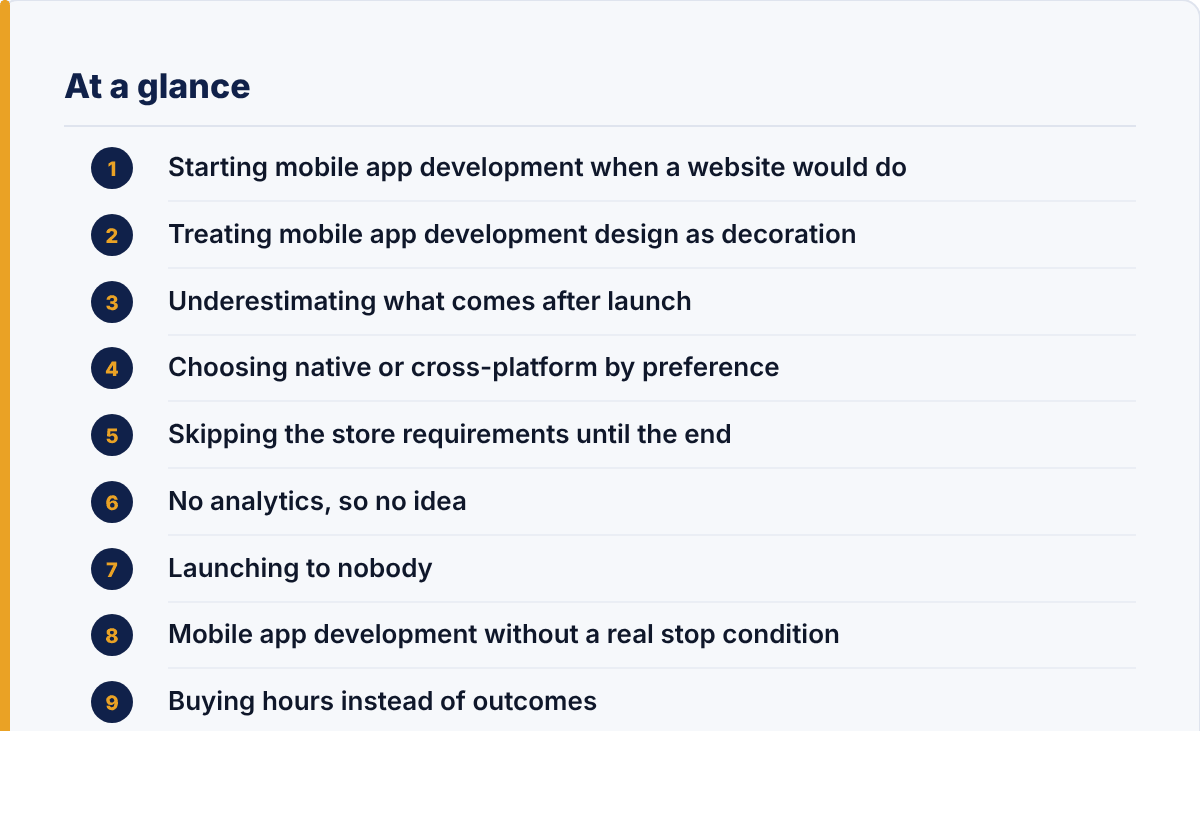
3. Underestimating what comes after launch
This is the biggest hidden cost in mobile app development. Both platforms update yearly, devices change, libraries deprecate, and an app left alone for eighteen months often will not build, let alone run. Budget for maintenance from the start, because an app is a commitment rather than a purchase.
4. Choosing native or cross-platform by preference
Neither approach to mobile app development is correct in general, although one is usually correct for you. Cross-platform suits apps that are mostly screens, forms and data. Native earns its extra cost when you lean hard on the camera, background processing, Bluetooth or heavy graphics. Decide from your feature list rather than from a developer’s comfort zone.
5. Skipping the store requirements until the end
Review rejections are ordinary and recoverable, but they are much cheaper to avoid. Account deletion, privacy labels, permission explanations and payment rules all shape the build. Apple’s App Store Review Guidelines are readable in an afternoon, and reading them before the architecture is set saves rework afterwards.
6. No analytics, so no idea
Teams finish mobile app development having instrumented downloads and nothing else. Then the app underperforms and nobody can say where people stop, because the funnel was never recorded. Decide the three events that mean the product is working, and have them in the first release rather than the third.
7. Launching to nobody
An app store is not a marketing channel. Nothing arrives on its own, so the launch plan has to exist before the build finishes, and it usually involves the audience you already reach. This is the point where a lot of good products stall.
8. Mobile app development without a real stop condition
Agree in advance what would make you stop investing, and write the number down while nobody is attached to the outcome. Otherwise version two gets funded out of hope, and the budget disappears in increments nobody individually objects to.
9. Buying hours instead of outcomes
Fixed-scope mobile app development with vague acceptance criteria produces arguments. So does an open-ended rate card with no checkpoints. The workable middle is a short discovery phase that produces a specification you both agree on, then build phases with something demonstrable at the end of each one.
Mobile app development questions we answer most weeks
How much does mobile app development cost?
The honest answer is that the range is so wide the number is meaningless without a feature list. What moves it most is not the screen count but the integrations, the compliance requirements and whether anything has to work offline, so scope those three before asking anyone for a figure.
How long does mobile app development take?
A focused first version is usually measured in months rather than weeks, and the part people underestimate is review, store setup and the fixes that follow real users. Build the plan backwards from a launch date you can defend.
Can mobile app development be done without a designer?
It can, and it usually costs more. The empty states, errors and confirmations that a designer settles on paper get settled during the build instead, by developers, one expensive decision at a time.
What to settle before you spend anything
Three things, and they take a week rather than a quarter. What single task the app must make easier, how you will know within sixty days whether it does, and who maintains it in year two. Projects that answer those tend to survive; projects that start with a feature list tend to grow one.
If you want to see how we scope this, our mobile app development page sets out the phases and what each one produces, and our UI and UX design page covers the walkthrough step that catches most of the gaps above.
Leave a Reply