Most thought leadership is ordinary content wearing a better job title. It summarises what the industry already agrees on, adds a statistic, and ends with a call to action. Nobody argues with it, nobody remembers it, and the person who wrote it quietly suspects as much.
The version of thought leadership that works is uncomfortable to write, because it requires saying something that could turn out to be wrong. Here are eight rules we hold ourselves to.
1. Have a position someone could disagree with
If every reasonable person in your field would nod along, you have written a summary. A position has an opposite that is also defensible, so start by asking what you believe that a competent competitor does not. That sentence is the piece; everything else is support.
2. Earn your thought leadership with something only you have seen
Opinion without evidence is just confidence. The evidence does not need to be a dataset, although it helps. It can be a pattern across the last thirty clients, a decision that went badly, or a number from your own dashboard.
When we write about outbound, we use our own accounts: 5,076 LinkedIn invitations produced 1,086 replies and 370 booked sales calls. The numbers matter less than the fact that they are ours and can be checked.
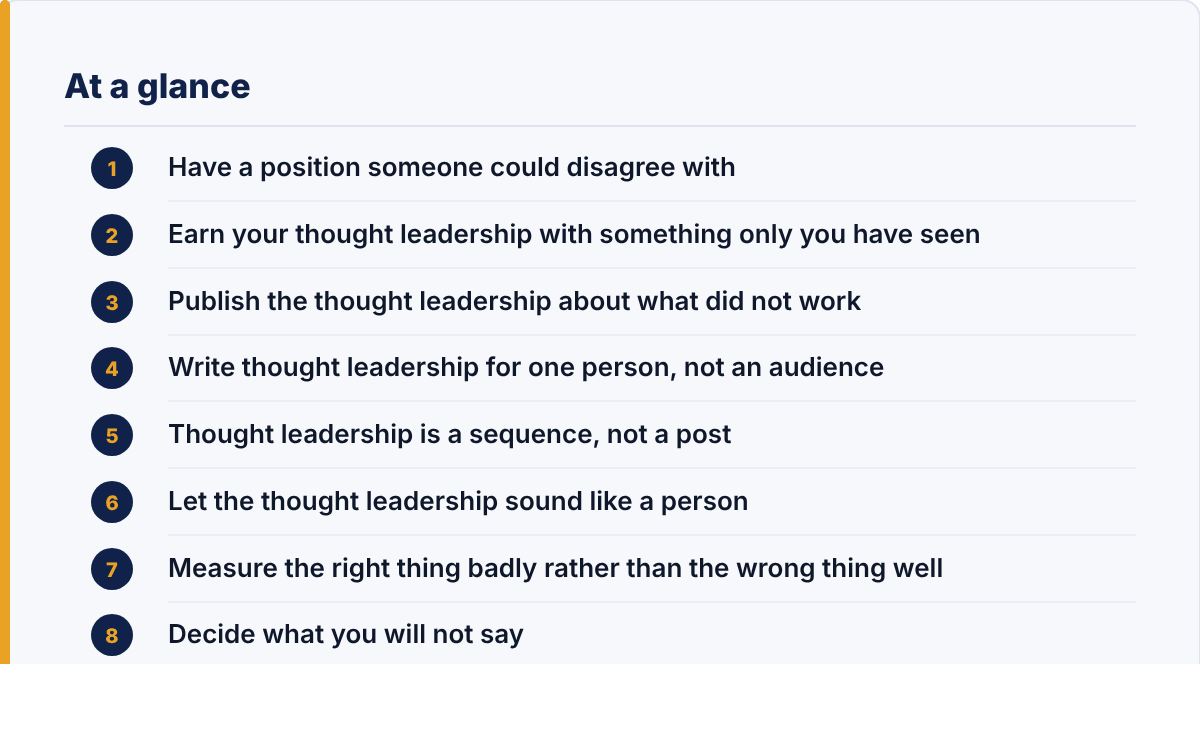
3. Publish the thought leadership about what did not work
This is the fastest credibility there is, and almost nobody does it. A post about a campaign that underperformed and why teaches more than three about success, because failure has specific causes while success has flattering ones.
4. Write thought leadership for one person, not an audience
Picture a specific buyer with a specific problem on a specific Tuesday. Then write to them. Content addressed to everyone reads as though it was written by a committee, which it often was.
5. Thought leadership is a sequence, not a post
One good piece of thought leadership changes nothing. The effect comes from returning to the same two or three arguments for a year, from different angles, until people associate the idea with you. So pick the arguments deliberately and be willing to be slightly repetitive, because you are far more bored of them than your reader is.
6. Let the thought leadership sound like a person
Committee review sands the edges off, and the edges were the point. If the founder said something sharp in the interview, keep it. Approval processes that remove every strong sentence produce safe pieces that nobody finishes.
7. Measure the right thing badly rather than the wrong thing well
Views are easy to count and tell you almost nothing. Better signals are messier: who replied, who mentioned the piece on a sales call, which argument came back to you from a stranger. Keep a simple note of those, since no dashboard will do it for you.
8. Decide what you will not say
Every real thought leadership position has a cost, so work out in advance which clients it might lose you and whether you accept that. The Content Marketing Institute’s research on what buyers actually value in thought leadership is a useful outside check if you want to sanity-test your assumptions first.

Thought leadership questions founders ask us
How often should thought leadership be published?
Less often than most calendars assume, and far more consistently. One substantial piece a month that advances the same argument beats weekly posts that advance nothing, because thought leadership compounds through repetition of an idea rather than volume of output.
Can thought leadership be ghostwritten?
The writing can. The position cannot. If the founder has not said the uncomfortable sentence out loud to a writer, the result will be competent and forgettable, which is the failure mode this whole article is about.
How do you know thought leadership is working?
When your argument comes back to you from someone you never spoke to. That is the signal, and no dashboard reports it.
The short version
Thought leadership is not a content format, it is a willingness to be specific in public. If a piece could have been published by three of your competitors with the logo swapped, then it is marketing, and that is fine, but it will not do this job.
If you want help building the sequence, our founder thought leadership page sets out how we work with founders, and the four-account case study is the evidence behind the figures above.
Leave a Reply