Custom mobile software development is priced as a build and lived with as a commitment. The quote covers writing the thing; the cost covers keeping it alive on two platforms that change every year, which is the part that surprises people in month fourteen rather than month two.
Here are seven custom mobile software development lessons, in the order they usually arrive.
1. Three decisions set most of the custom mobile software development budget
Whether it works offline, whether it needs real-time updates, and whether it must behave identically on both platforms. Each one roughly doubles the engineering in its area, and all three are decided in conversation rather than in code. Settle them before the estimate, since an estimate against an unsettled brief is a guess wearing a number.
2. Offline is a different product
“It should work on the train” sounds like a feature and is an architecture. Data has to be stored locally, changes have to be queued, and two people editing the same record offline have to be reconciled when they reconnect. If your users are genuinely offline sometimes, build for it from day one. If they are not, say so out loud and save the money.
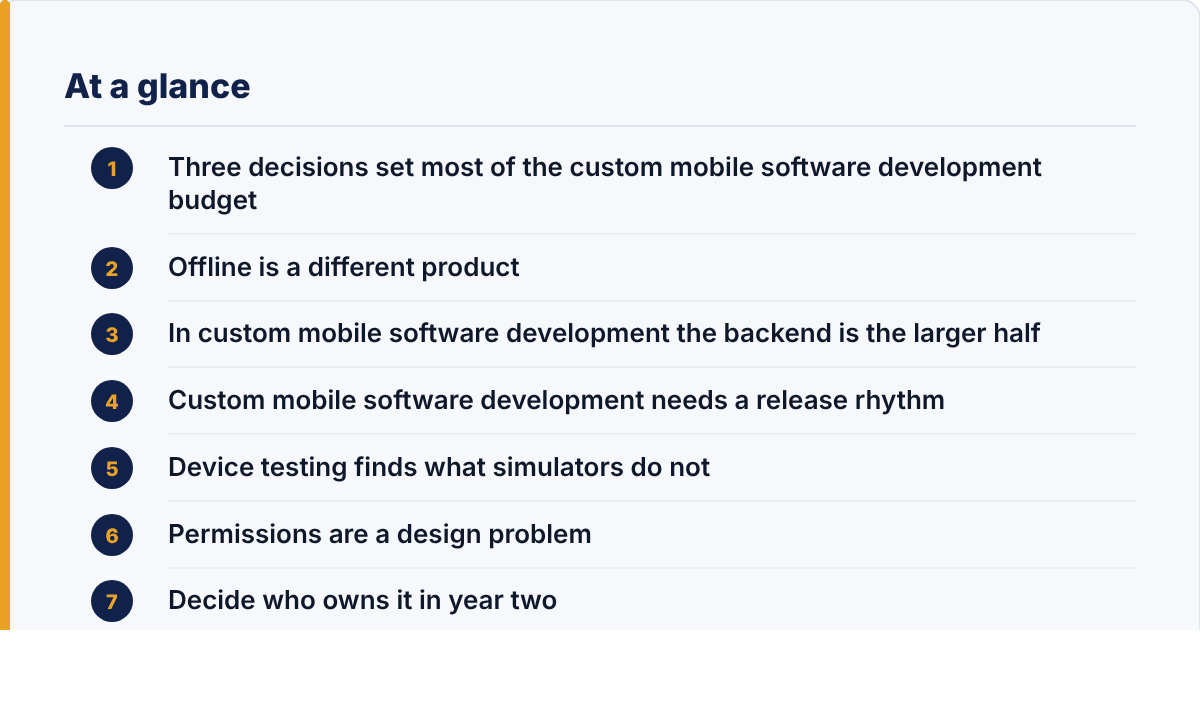
3. In custom mobile software development the backend is the larger half
People picture screens, and the screens are the visible part. Authentication, permissions, notifications, syncing, an admin interface and the reporting someone will ask for in month three all live behind them. When a quote looks low, this is normally what is missing.
4. Custom mobile software development needs a release rhythm
App store review adds days, users update on their own schedule, and you will be supporting two or three versions at once for a while. So plan releases as a rhythm rather than as events, and make sure the app can tell a user, politely, that their version is too old.
5. Device testing finds what simulators do not
Older phones, small screens, poor connections, low battery modes and the accessibility settings people actually use. Keep a small shelf of real devices, including one that is four years old, because that is what a meaningful share of your users carry.
6. Permissions are a design problem
Location, camera, notifications and contacts each need a reason the user understands at the moment you ask. Ask badly and they decline permanently, which quietly breaks the feature for that user forever. Apple’s privacy guidance in the Human Interface Guidelines is short and worth reading before the screens are drawn.
7. Decide who owns it in year two
Platform updates, library deprecations, certificate renewals and store policy changes arrive whether or not you have a team. An app left alone for eighteen months often will not build, let alone run. Budget maintenance as a line item from the start, and name the person or the agreement that covers it.
Custom mobile software development questions we are asked
What does custom mobile software development cost?
The three decisions in lesson one move the figure more than the screen count does, which is why quotes given against a feature list alone vary so widely. Settle offline, real-time and platform parity, and the range narrows sharply.
Is custom mobile software development worth it over an off-the-shelf app?
Only where the workflow is genuinely yours. If a packaged product covers it with awkward edges, the awkward edges are usually cheaper than a build plus a decade of maintenance.
Who maintains custom mobile software development after launch?
Decide before you sign: your team, the original builder under an agreement with a named response time, or a third party with a documented handover. Certificates and platform updates do not wait for the question to be settled.
Where projects go over, in our experience
Custom mobile software development rarely goes over on the screens, which are estimated carefully because everyone can picture them. It goes over in the admin interface nobody specified, the reporting requested in month three, and the week lost to a store rejection that a half-hour of reading would have avoided. None of those are surprises in general, only in particular.
What a sound estimate contains
A sound custom mobile software development estimate contains a short discovery phase with its own price, those three decisions written down as answered, the backend scoped separately from the screens, a named list of devices to be tested, and a maintenance figure for year two. An estimate missing any of them is not wrong so much as incomplete, and the gap will be filled later at a worse moment.
Our custom software development page sets out how we phase this, and the mobile app development page covers the store and release side in more detail.
Leave a Reply