Most people discover online reputation management on a bad morning. Something unflattering is on page one, a review is sitting there at one star, or a former employee has written a thread. The instinct is to get it taken down, and that instinct is usually the expensive one.
Here is how this actually works, including the parts nobody selling it enjoys explaining.
1. Online reputation management rarely means removal
Lawful, accurate content generally stays up. Platforms remove things that break their rules, and search engines de-index very little. So the realistic goal is almost always to change what dominates the first page rather than to erase what is on it.
Anyone promising guaranteed removal is either describing a narrow legal case or is not being straight with you.
2. Start online reputation management by working out what people search
Your brand name, your founder’s name, and the combinations with “reviews”, “complaints” or “scam” attached. Check each one from a logged-out browser, because your own results are personalised and will quietly reassure you.
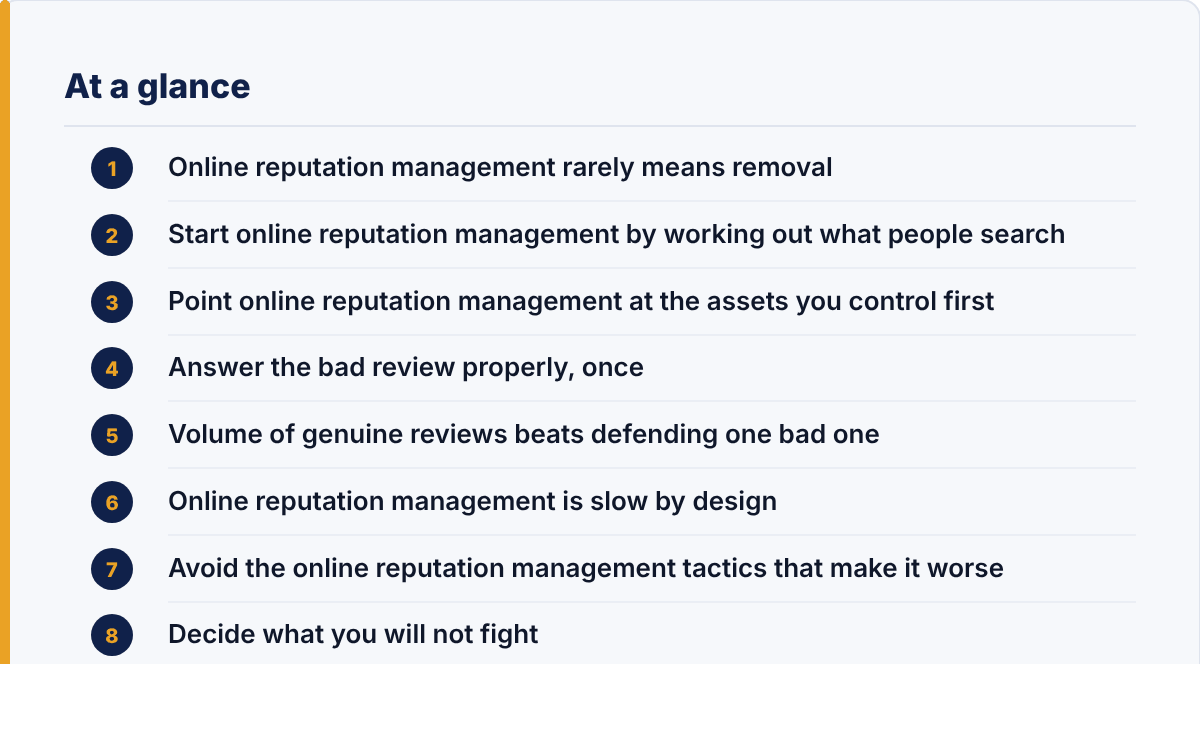
3. Point online reputation management at the assets you control first
Your site, your profiles, your directory listings and your social accounts are pages you can improve immediately, and they are the cheapest way to fill the first page with things you wrote. This is unglamorous and it is most of the work.
4. Answer the bad review properly, once
A short, specific, non-defensive reply does more for the next reader than for the person complaining. Acknowledge the facts, say what changed, and offer to continue elsewhere. Then stop, because an argument that continues publicly is a worse result than the original review.
5. Volume of genuine reviews beats defending one bad one
Most online reputation management effort is misplaced here. One angry review among six is damaging; among two hundred it is ordinary and even useful, since a perfect score reads as fake. So the most effective reputation work is often just asking satisfied customers at the right moment. Never incentivise a rating, though, because platforms detect it and the penalty is worse than the problem.
6. Online reputation management is slow by design
Search results move over months, not days. A new page needs to be found, trusted and preferred before it displaces an older one, and nothing you buy changes that timeline. Budget on a six-month horizon and judge progress by what is appearing on page two.
7. Avoid the online reputation management tactics that make it worse
Fake reviews, mass takedown requests against lawful criticism, and legal threats against individuals all tend to create a second, larger story. The United States Federal Trade Commission’s guidance on endorsements and reviews sets out what is actually prohibited, and it is worth reading before anyone suggests being clever.
8. Decide what you will not fight
Some criticism is fair. Some is from a competitor and will never be removed. Some will be forgotten faster if ignored. Write down in advance which category a new item falls into, because that decision is much harder to make calmly at eight in the morning.
What to put in place before you need it
Claim every profile that carries your name, even the ones you do not use, because an unclaimed listing is the one that ranks awkwardly later. Keep a simple document of who responds, within what time, and who signs off anything legal. Good online reputation management is mostly having decided these things on a quiet day.
Online reputation management questions we get asked
How much does online reputation management cost?
It depends almost entirely on whether you need publishing or defending. Claiming profiles and improving pages you already own is modest and mostly one-off. Displacing an established negative result on a competitive brand name is a six-month programme, and online reputation management priced as a quick fix is usually selling takedown requests that will not succeed.
Can online reputation management remove a Google result?
Only where the content breaks a platform rule or a law. Otherwise the work is crowding it out, which is slower and considerably more reliable.
Is online reputation management worth it for a small business?
Yes, and the cheap version is most of the value: claim the listings, ask happy customers for reviews, reply to the unhappy ones once. That is online reputation management, and it costs attention rather than money.
The short version
Online reputation management is mostly publishing, answering and waiting. The firms that do it well spend their time building pages worth ranking, while the ones that do it badly spend yours on takedown requests that were never going to succeed.
If you want help with the publishing side, our digital PR page covers how we earn coverage that ranks, and our public relations page covers the handling of a story while it is live.
Leave a Reply